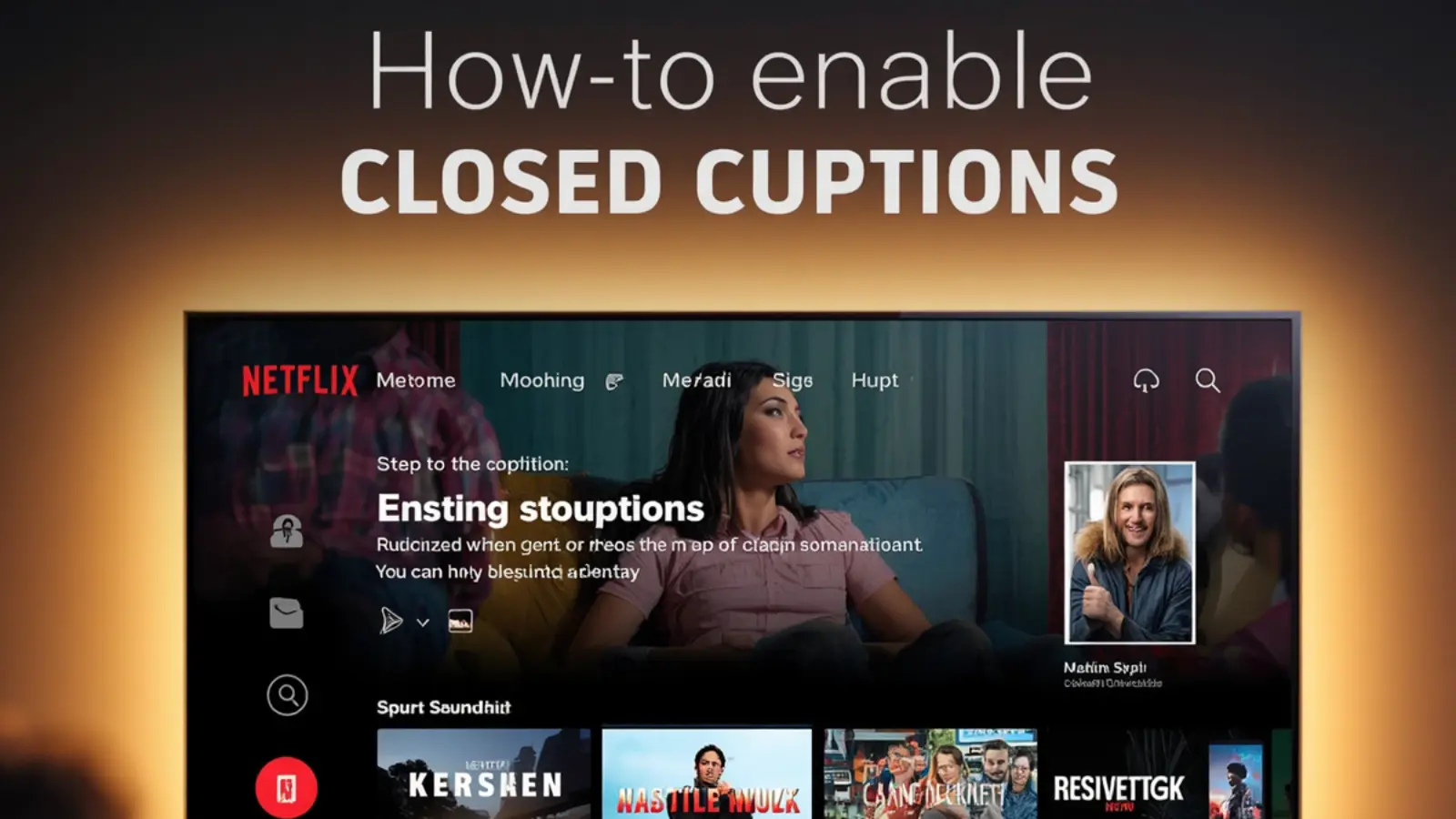
How to get closed caption on Netflix means activating the subtitle feature that displays spoken dialogue, sound effects, and relevant audio cues as on-screen text so viewers can follow content more clearly, whether for accessibility needs, noisy environments, language learning, or simply catching every line.
This built-in option works across phones, tablets, TVs, computers, and streaming devices with just a few taps or clicks.
Closed captions transform the Netflix experience by making stories more inclusive and easier to absorb. Many people turn them on during late-night watching, in shared living spaces, or while multitasking.
The process stays consistent yet adapts slightly by device, and once enabled it often remembers your preference for future sessions. Below you’ll find twelve fresh angles that go beyond basic instructions, each packed with twelve practical points so you can activate captions confidently wherever you stream.
Discovering the Caption Toggle Hidden in Everyday Playback Controls 🎛️
- Open any title and press play so the standard progress bar appears along the bottom of the screen.
- Look toward the lower right corner where a small speech-bubble or CC icon usually sits next to the volume and full-screen buttons.
- Tap or click that icon once; a menu slides up listing available subtitle languages and styles.
- Select your preferred language—most often English [CC]—and watch the text appear within a second or two.
- If the icon seems missing, pause the video briefly; some interfaces hide controls until you interact.
- On touch screens, a light double-tap near the bottom edge often reveals the full control strip including captions.
- Experiment with turning the feature off and on again to confirm the change registers immediately.
- Notice that the same toggle works whether you started the title from your home screen, Continue Watching row, or search results.
- After enabling, let a few scenes play to verify timing stays synchronized with the audio.
- If text fails to show, exit the title completely and relaunch it so the player reloads with the new setting.
- Use this method first on a short episode to practice before diving into a long movie.
- Once comfortable, the toggle becomes second nature and saves time every session.
Mapping Caption Activation Across Phone and Tablet Screens 📱
- Launch the Netflix app and sign in with the profile that holds your viewing history.
- Choose a show or movie and start playback in full-screen mode for clearer button visibility.
- Tap the screen once to bring up the bottom control bar if it has faded away.
- Locate the speech-bubble icon—usually positioned near the right side beside the cast and settings symbols.
- Tap it and choose the language track labeled with [CC] for closed captions rather than plain subtitles.
- On Android devices the menu may list both audio and subtitle options in one panel; pick the subtitle section.
- iOS users often see a cleaner list; select the desired language and close the menu.
- Rotate the device to landscape if the icons feel cramped in portrait orientation.
- Test the change by watching a dialogue-heavy scene to ensure text size remains readable.
- If captions appear too small, exit to the main menu and adjust accessibility text size in your phone settings.
- Keep the phone unlocked and the app in the foreground so the player does not reset preferences.
- After success, note that the same profile often carries the preference to other mobile devices signed in under the same account.
Enabling Captions on Living-Room Television Interfaces 📺
- Use the Netflix remote or the app’s on-screen cursor to highlight and open any title.
- Start playback and press the up or down arrow on the remote to reveal the control overlay.
- Navigate rightward until the CC or speech-bubble icon becomes highlighted.
- Press the select or OK button to open the subtitle language list.
- Scroll to the closed-caption option for your language and confirm the choice.
- Some smart TVs display a separate “Subtitles” menu under the options gear; open that if the CC icon is absent.
- After selection, wait a moment for the player to apply the track without interrupting the stream.
- If the remote feels slow, open the Netflix app on a phone connected to the same account and use the mobile remote feature.
- Check that the TV’s own accessibility settings do not override or conflict with Netflix captions.
- For older television models, restart the Netflix app from the home screen after changing the setting.
- Confirm captions remain active when you switch episodes within the same series.
- Once set, many televisions remember the preference for that profile across future viewing sessions.
Activating Subtitles Through Computer Browser Players 💻
- Visit netflix.com in a supported browser such as Chrome, Firefox, Edge, or Safari.
- Sign in and begin playing a title so the full web player interface loads.
- Move the mouse pointer toward the bottom edge to make the control bar appear.
- Click the speech-bubble icon that sits near the far right of that bar.
- From the dropdown, choose the closed-caption language track you prefer.
- Watch the text render almost instantly over the video window.
- If the icon is missing, press the keyboard space bar to pause and then resume; controls often reappear.
- For greater readability, open the full settings gear and explore caption style options when available.
- Avoid browser extensions that claim to manage subtitles; they can interfere with the native player.
- Clear the browser cache only if captions refuse to load after several attempts.
- Test the same title in an incognito or private window to rule out extension conflicts.
- Bookmark the title page so you can return quickly and verify the setting persists.
Using Streaming Sticks and Game Consoles for Caption Control 🎮
- On a Roku, Fire TV, or Apple TV device, open Netflix and start any program.
- Press the asterisk, options, or menu button on the remote to open the player overlay.
- Highlight the CC or Subtitles entry and press select.
- Choose the closed-caption track and exit the menu.
- For PlayStation or Xbox consoles, press the corresponding options button while the video plays.
- Navigate to the subtitle section within the on-screen Netflix menu.
- Confirm the language and return to full-screen viewing.
- If the console interface feels cluttered, pair a mobile device as a remote through the Netflix app.
- Restart the streaming stick or console if the caption choice does not stick after selection.
- Check that the device firmware is current so the Netflix app supports the latest caption features.
- Practice the button sequence on a short clip before committing to a full movie.
- Once successful, the same steps apply to most future titles on that hardware.
Adjusting Caption Appearance for Comfort and Clarity ✨
- After enabling captions, open the settings or gear icon inside the player when available.
- Look for style, font, or appearance options that let you change text color and background.
- Increase font size if the default text feels too small on a large television.
- Choose a high-contrast combination such as white text on a semi-transparent black box.
- Test different edge styles—drop shadow or outline—to improve legibility against bright scenes.
- Avoid pure white text without a background when the video contains lots of light imagery.
- On mobile devices, system-wide accessibility text scaling sometimes influences Netflix captions.
- Revisit the style menu after changing devices because preferences do not always transfer perfectly.
- Keep the background opacity moderate so the video itself remains visible behind the text.
- If style options are limited, rely on the device’s built-in display settings for overall contrast.
- Watch a few minutes after each change to decide whether the new look feels natural.
- Save the preferred style by continuing playback; many players lock it in for the current session.
Troubleshooting When Captions Refuse to Appear 🔧
- Confirm you selected a track marked [CC] rather than a plain subtitle track that may be unavailable.
- Exit the title completely, return to the Netflix home screen, and relaunch the same program.
- Sign out of the profile and sign back in to refresh account-side preferences.
- Restart the device itself—phone, TV, or streaming stick—to clear temporary player glitches.
- Check your internet connection; unstable streams sometimes delay subtitle tracks.
- Update the Netflix app to the latest version available in your app store or device menu.
- On smart TVs, remove and reinstall the Netflix channel if captions stay missing.
- Verify the title actually offers closed captions; some older or niche content may lack them.
- Try a different title known for strong accessibility support to isolate the issue.
- Disable any VPN or proxy that might interfere with content delivery.
- Contact Netflix help through the app’s Help section if none of the above restores captions.
- Document the exact device and error so support can guide you faster next time.
Building a Habit of Caption Use for Better Focus 🧠
- Start every new series by enabling captions during the first episode so the habit forms early.
- Use captions in noisy environments such as kitchens or shared apartments to stay locked on dialogue.
- Turn them on during language-learning sessions to reinforce vocabulary and pronunciation.
- Enable captions for fast-talking characters or heavy accents that might otherwise slip past.
- Combine captions with lowered volume during late-night viewing to avoid disturbing others.
- Review key plot points by pausing and rereading a caption line when needed.
- Notice how captions highlight important sound effects that pure audio might bury.
- Practice switching captions on and off quickly so the action becomes automatic.
- Share the habit with household members so everyone benefits from clearer storytelling.
- Track whether comprehension improves after a week of consistent caption use.
- Apply the same mindset to other streaming platforms once Netflix feels natural.
- Celebrate small wins—finishing a complex episode without rewinding—as proof the system works.
Exploring Profile-Specific Caption Preferences 👤
- Create or switch to the profile you use most often before adjusting any settings.
- Enable captions inside that profile so the preference stays tied to your viewing history.
- Test the setting on a second device signed into the same profile to confirm it carries over.
- If multiple people share an account, keep captions off on kids’ profiles unless needed.
- Review the profile’s maturity and language settings; they sometimes influence available tracks.
- After changing profiles, recheck the CC icon because each one maintains independent choices.
- Use a dedicated “accessibility” profile if one household member relies heavily on captions.
- Sign out of secondary devices occasionally to force a fresh preference sync.
- Avoid guest or temporary profiles when testing permanent caption habits.
- Note that some older profiles may need a full re-login after major Netflix updates.
- Keep the primary profile’s caption choice consistent across phone, TV, and laptop.
- Periodically verify the setting remains active after Netflix rolls out interface refreshes.
Leveraging Captions During Travel and Shared Spaces ✈️
- Enable captions on a downloaded title before boarding a plane or train with limited connectivity.
- Use the offline feature so captions remain available even without an active internet signal.
- In hotel rooms with thin walls, lower the volume and rely on text to follow every scene.
- Share a single device with family members and keep captions on so everyone stays aligned.
- Activate captions in busy airports or cafés where ambient noise drowns out dialogue.
- Pair captions with noise-cancelling headphones for a focused travel viewing experience.
- Download several episodes in advance so the caption track is already embedded.
- Check device battery levels; longer caption sessions on mobile can increase power draw slightly.
- Switch to a larger tablet screen when possible for easier text reading on the go.
- After travel, sync the same profile on home devices so the preference stays ready.
- Teach travel companions the quick toggle method so they can adjust independently.
- Reflect after the trip on how captions reduced frustration in unpredictable environments.
Combining Captions with Other Accessibility Features ♿
- Pair closed captions with audio description tracks when both are offered for fuller access.
- Increase overall system text size on phones so Netflix captions scale accordingly.
- Enable high-contrast mode on the device to make on-screen text pop more clearly.
- Use screen readers sparingly alongside captions if additional spoken feedback helps.
- Adjust television brightness and sharpness so caption backgrounds remain distinct.
- Explore Netflix’s own accessibility help pages for device-specific tips that complement captions.
- Test captions with different remote control methods—voice, touch, or physical buttons.
- Keep firmware and apps updated so new accessibility improvements reach the player.
- Combine captions with reduced motion settings if rapid scene changes cause discomfort.
- Share successful combinations with friends who have similar viewing needs.
- Revisit settings after any major device or Netflix update to restore preferred pairings.
- Treat captions as one flexible tool within a broader set of viewing supports.
Turning Caption Mastery into Everyday Streaming Confidence 🚀
- Practice the enable steps on three different devices within one week until they feel automatic.
- Create a short personal checklist of the most common buttons or icons you use.
- Teach one friend or family member the process so the knowledge spreads.
- Notice how captions free mental energy previously spent rewinding or guessing dialogue.
- Apply the same confidence to other platforms once Netflix feels effortless.
- Keep exploring new titles knowing that captions will be ready when needed.
- Celebrate finishing complex series without missing key lines thanks to the text support.
- Adjust style preferences seasonally if lighting or seating arrangements change.
- Stay curious about upcoming Netflix accessibility improvements that may expand options.
- Use captions as a quiet productivity tool during background viewing while cooking or working.
- Maintain the habit even on familiar shows to catch subtle sound design details.
- Approach every new streaming session with the calm assurance that clear dialogue is only a few taps away.
Final Thought
Closed captions unlock clearer, more inclusive Netflix viewing for anyone who wants to catch every word. From the quick mobile toggle to television remote sequences and browser clicks, the steps stay simple once practiced.
Experiment with styles, troubleshoot the rare glitch, and build the habit across devices and profiles. Start with one title tonight, enable the speech-bubble icon, and notice how much easier the story becomes.
Then share your favorite caption tip with someone else who streams—because better accessibility benefits everyone.

Zayden Cross specializes in creating bold, viral-ready captions that instantly grab attention. His writing style blends modern trends with strong emotional hooks, making content highly engaging. Perfect for users looking to stand out on social media.